About

A journey through traditions, and back to practice

This work grew out of a lived path — through churches, temples, and long hours on a cushion — and out of a love for the handmade objects that keep a practice honest.

“I started as a Christian, I discovered I was a Buddhist, and I returned as a Hindu without having ceased to be a Christian.”

The sentence this work is built on

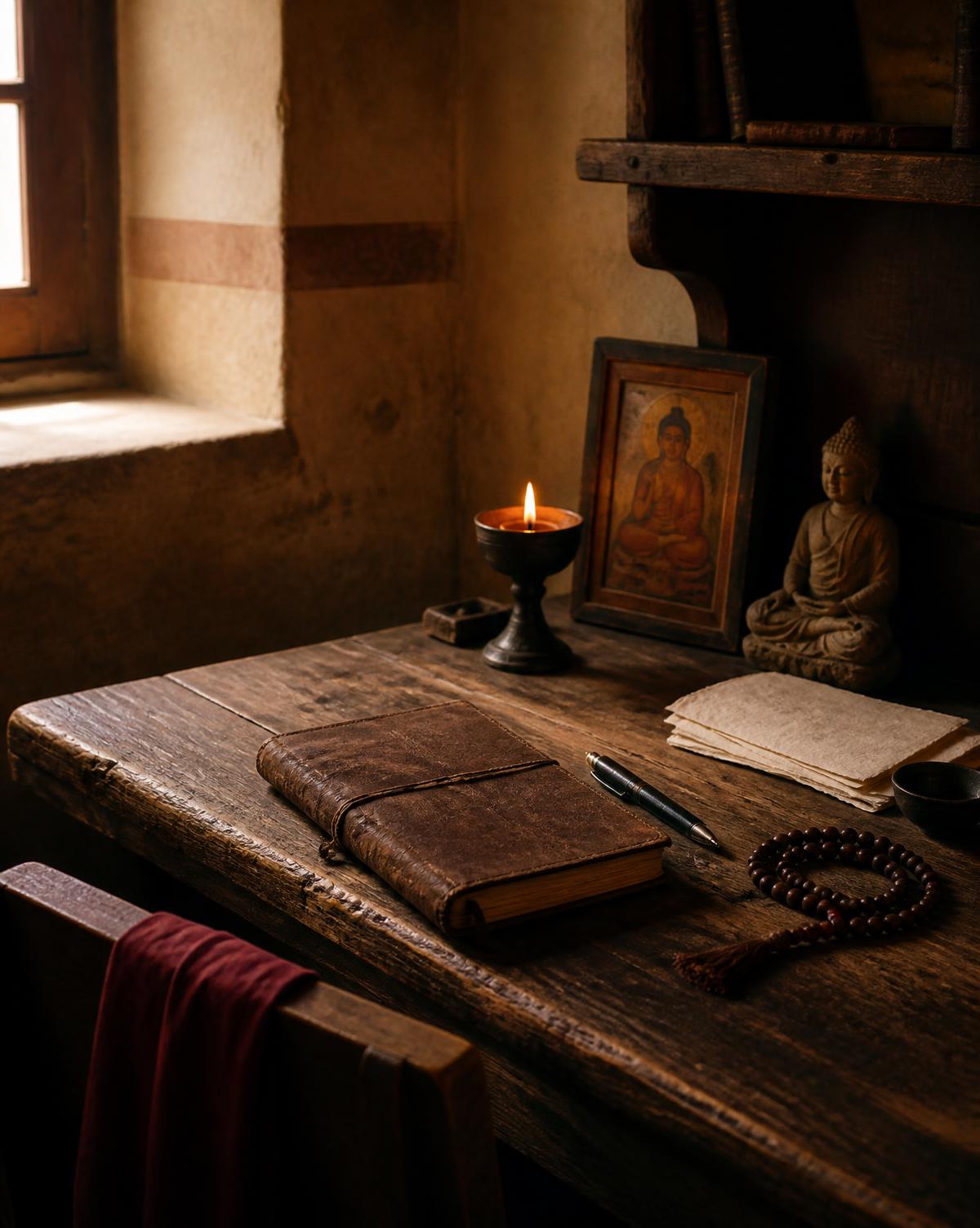
A monastery desk with a journal, prayer beads, an icon and a stone buddha

Founder story

Exploration, transformation, and a slow deepening

Nothing was abandoned along the way. Each tradition left something behind that the next one needed — a posture, a sound, a form of patience.

01Beginnings

Raised in hymns and candlelight

The first language of the sacred was a church: incense, kneeling, memorised prayer, the hush before the reading. Long before I had words for it, I understood that certain rooms ask you to become quieter than you are.

02The Turning

Learning that repetition is a door

Years later, a teacher put a strand of beads in my hand and asked for nothing but repetition. What I had known as devotion I met again as practice — mantra, breath, the same syllable a hundred and eight times until the mind stops arguing.

03The Return

Sitting down with what remains

Silence taught me the rest. Not a new belief to replace the old ones, but a way of holding all of them lightly: attention, kindness, and the willingness to sit still with whatever arrives.

Personal philosophy

Respect first, then curiosity

Traditions are not interchangeable and they are not competing. Each one has its own grammar, its own lineage, its own dignity. The honest posture is to learn slowly, ask permission, and quote sources.

What connects them, in my experience, is not doctrine but practice: silence, repetition, compassion, and the discovery that attention itself is a form of love.

Why this work exists

Because practice needs something to hold onto

Sitting is free, and yet almost everyone I know who keeps a daily practice keeps it because of an object: a strand of beads, a bowl, a worn cushion, a notebook.

So World Oral Traditions makes and gathers those things, and publishes the teachings that explain how to use them. Craftsmanship in service of devotion — nothing more complicated than that.