Learn · 05
Choosing Your Mala
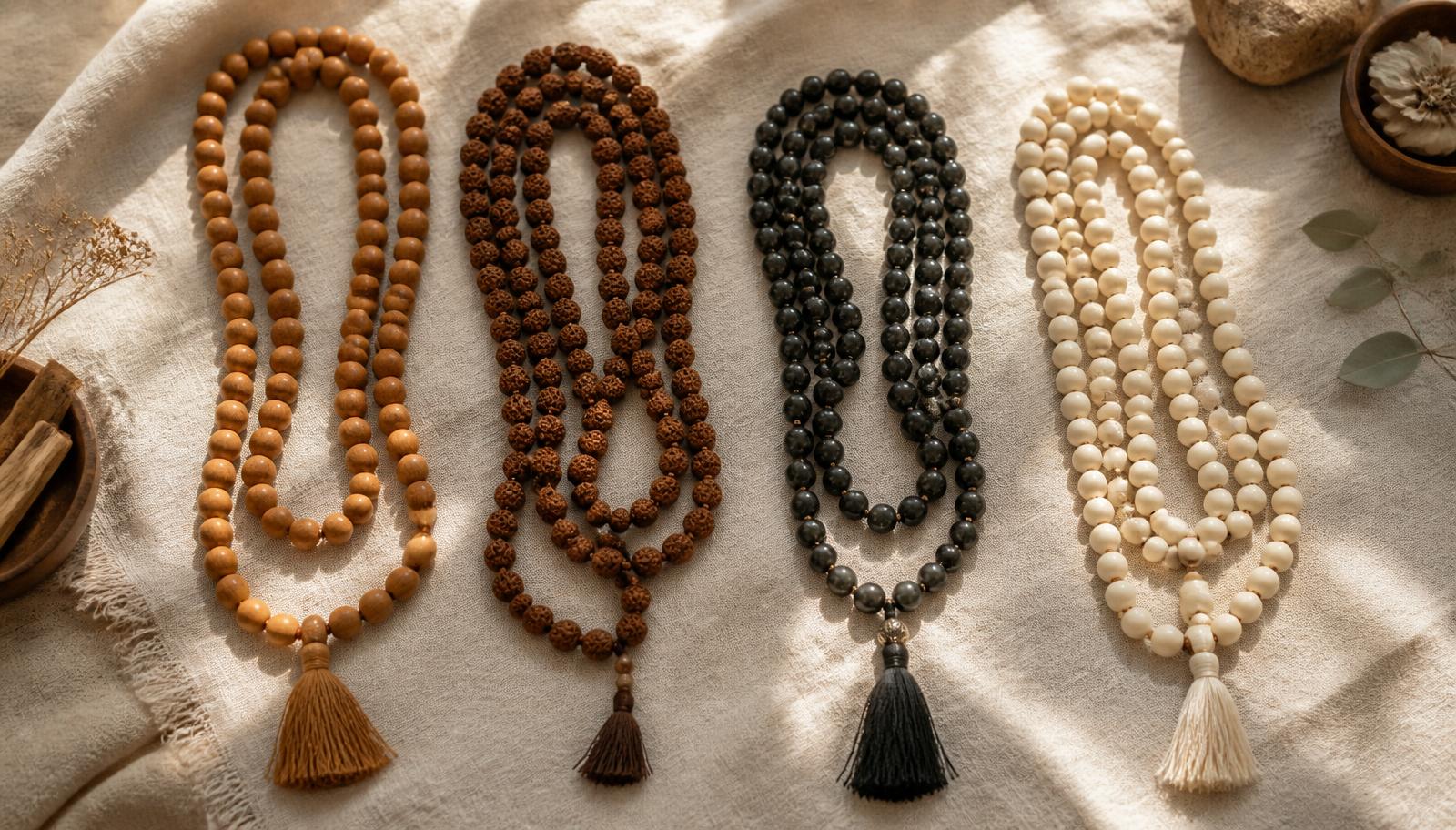
The selection is small for now — one full 108-bead mala and a few wrist malas — so the choice comes down to form, fit, and how you plan to practise.
Form
Wrist mala vs. full 108 mala
A wrist mala is compact, wearable, and convenient for practice on the go or for counting partial rounds throughout the day, but its shorter length makes it harder to track full rounds of 108. A full mala is better suited to a seated practice where you're completing full rounds and want the guru bead to mark a clear beginning and end. Many practitioners eventually own both and use them for different parts of the day — there's no need to choose only one. At the moment we make a small number of wrist malas and a single full 108-bead mala, so this is the main decision to make.
Fit
Bead size and hand size
Larger beads (roughly 10–12mm) are easier to feel and move quickly between the fingers, which can help beginners keep count without looking down. Smaller beads (6–8mm) sit closer to the hand and are often preferred for wrist malas or for practitioners with smaller hands. For a wrist mala specifically, the strand should stretch comfortably over the hand without excessive pulling and rest with some give at the wrist rather than fitting tightly.
Material
What it's made from, and how it wears
Seed materials like rudrāksha and bodhi seed are light, develop a patina with handling, and are traditional choices for daily japa. Wood is similarly light and quiet against the fingers. Gemstone beads are heavier, more varied in color and pattern, and generally more durable against everyday wear, though some softer stones can chip if dropped repeatedly. If you plan to wear a mala daily as a bracelet, consider how it will hold up against water, lotion, and friction.
How to decide
By intention, or by material
There are two reasonable starting points, and neither is more correct than the other. You can begin with an intention or quality you want to support in practice — our Collections gather malas by intentions like steadfastness, clarity, or transition, each with the traditions and gemstone associations behind it — and let that guide the material. Or you can begin with a stone or wood you're simply drawn to, browse our Gemstone Guide to understand what it's associated with, and let the intention follow. Both are legitimate ways to arrive at a mala that feels right.
Buying for someone else
If you're buying a gift
A wrist mala is generally a safer gift than a full mala, since it doubles as jewelry even for someone without an established practice. Choose by material or color rather than trying to guess an intention on someone else's behalf, and consider including a short note pointing to this Learn section so they have somewhere to start if they're new to the practice. If the recipient already practices within a specific tradition, it's worth asking rather than assuming what they use.
Ready to browse? The current designs are a handful of wrist malas and one full mala necklace. Gemstone strands will follow. You can also explore Collections to shop by intention.