Learn · The Jesus the Christ Mala
Jesus the Christ
A mala strung in the colors of compassion, truth and love — and the oral tradition of a boy who went east to hear his Father's words spoken aloud.
This strand is made for anyone who prays the name of Jesus and also loves the Vedas, and who has never accepted that those two loves must be kept in separate rooms. It is a mala — beads counted by the hand while a name is repeated by the breath — and it carries a story told by voice long before it was ever written down.
Compassion, so the heart stays soft.
Truth, so the mind stays honest.
Love, because that is what moved him.
The oral tradition
The years no gospel records
The gospels show him in the Temple at twelve, questioning the teachers and answering them, and then close the door on his youth. He is not seen again until he is about thirty. Eighteen years pass in silence on the page.
But not in the telling. In Kashmir, in Ladakh, in Punjab and among storytellers far older than the printing press, there is a tradition that he went east. In 1894 the Russian traveller Nicolas Notovitch published The Unknown Life of Jesus Christ, describing a manuscript he said was read aloud to him at the Hemis monastery in Ladakh — the Life of Saint Issa. In that account the boy leaves home at thirteen and travels with a merchant caravan toward Sindh, and spends his hidden years among the brahmins and the Buddhist monks before returning to Israel to teach.
Thirteen is not an arbitrary age. In Jewish custom a boy became a son of the commandment then — accountable, counted among the men, of an age when a family would begin to arrange a betrothal. That was the appointed turn in the road: a trade, a wife, a household in Galilee. The tradition says he did not take it. It says he joined a caravan instead, and in some tellings he travelled under the protection of his kinsman — the uncle remembered in later Western legend as Joseph of Arimathea, a merchant whose trade routes ran far from Nazareth.
People have always asked the same thing of this story: what on earth would he have gone there to do?
Why India
He went to hear his Father's words
He went to study his Father's words in the Vedas.
The Vedas name no human author. The tradition holds that they were not composed but heard — śruti, "that which is heard" — received by the rishis out of the same Cosmic Spirit from which all things come. If that Spirit is the Father he spoke of, then the Vedas are his Father's speech, kept intact by human breath across thousands of years.
And there was only one way to receive them. Not by reading. The Vedas were guarded as sound: syllable, pitch, meter, pause, mouth to ear, teacher to student, for as long as anyone can measure. A student went to where the teacher was, sat down, and listened until the sound lived in him exactly as it had been given. That is what an oral transmission is. If he wanted the Vedas, India is where he had to go, and a lineage of voices is what he had to sit before.
God did not leave us here without a word. He left us the Vedas — a gift to humanity telling us who and what we are.
Anyone who has fallen in love with the Vedas understands the rest without being persuaded. Once you have heard them, there is nothing else you feel compelled to do. You would cross a desert to hear them again. Love is what would have drawn him there, and love is a good enough reason for a journey — it is the only reason anybody has ever really had.
Whether the caravan can be proven is not the point of this page. The story is carried by voice, and this is a house built for what voices carry. It is offered here as it was received: openly, without argument, for those who find something true in it.
The strand
Three colors to pray with
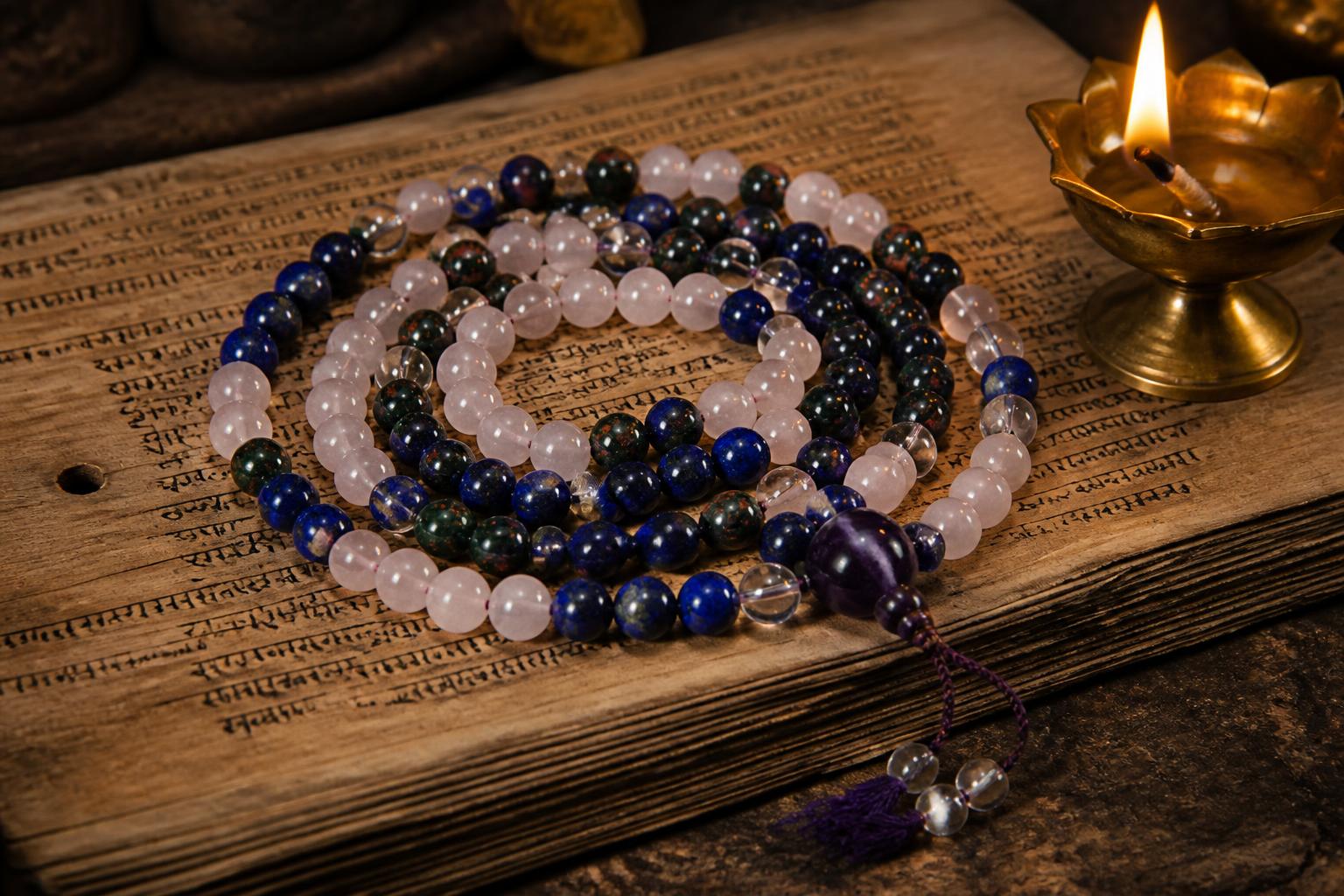
The mala is arranged around three colors rather than three claims. Rose, for the compassion that keeps the heart soft. Blue, for the truth that will not be counterfeited. Green, for the love that gives itself. A touch of clear light runs between them as a marker, so the fingers can find their place on the round without looking.
Each bead is individually hand-knotted, so the strand keeps a steady tactile rhythm and the beads stay secured on the cord if it ever gives way. The exact stones, their history and the way they are strung are described on the product page, where the material mala is shown. See What Is a Mala? for the parts of a strand, and How to Use a Mala for the practice.
The recitation
Words for the beads
A mala asks for one thing: a few syllables repeated until the repetition carries you. Two are offered here — one from the Christian East, one from the Vedic tradition — kept in their own words, as they were given. Pray one round in one voice, and the next round in the other, if that is where your heart lives.
The Christian round
Lord Jesus Christ, Son of God, have mercy on me.
The Jesus Prayer — the prayer of the hesychasts of the Christian East, said on knotted prayer ropes for well over a thousand years, one knot, one breath, one repetition. Its still older root is the Aramaic watchword the first communities prayed: Maranatha — "Come, Lord" — preserved in 1 Corinthians 16:22 and in the Didache, among the oldest Christian teaching we have. If the full prayer feels long for counting beads, Maranatha alone will carry a whole round.
The Vedic round
Oṃ bhūr bhuvaḥ svaḥ · tat savitur vareṇyaṃ · bhargo devasya dhīmahi · dhiyo yo naḥ pracodayāt
The Gayatri mantra, Rig Veda 3.62.10 — a prayer to the divine light: may we meditate on the excellent glory of the divine source of light; may it illumine our understanding. It is the best-known recitation in the Vedic tradition and the one most often given with a mala — which is to say, it is exactly the kind of verse the tradition in this article says a boy once crossed a desert to hear spoken aloud.
Those two prayers meet at a single point, and it is worth meditating on. The Gospel of John opens, "In the beginning was the Word" — Logos, the divine speech through which all things were made. The Vedic tradition knows the same mystery as Vāk, sacred speech, the sound out of which the worlds arise — the Rig Veda devotes an entire hymn to her (10.125). The Gnostic writings gathered at Nag Hammadi circle this same ground: salvation that arrives as a voice, a call, a word heard. These are parallels, not one teaching in two costumes — each tradition keeps its own names. But if you hold a bead and repeat a word, both agree on this much: the word is not a description of the divine. It is an address to it.
Practice
How it is prayed
One bead, one repetition, one breath. The name of Jesus alone is enough — spoken under the breath or held silently in the mind — and this is the oldest Christian way of praying with beads: a short name repeated until it settles below thought.
Some who pray this strand set the name of Jesus on one round and a Vedic prayer on another, keeping each in its own tradition and its own words rather than blending them. Others simply move from bead to bead in silence. Nothing here requires a teacher's permission, and nothing here asks you to leave the faith you already have.
When you reach the guru bead, pause. Turn back the way you came, and begin again if you wish. How to Use a Mala covers the mechanics.
A bead. A breath. A name. A return.