Learn · Prayer beads
What Are Prayer Beads?
A counted strand held in the hand while words are repeated. That much is shared across many traditions — nearly everything else belongs to a particular one.
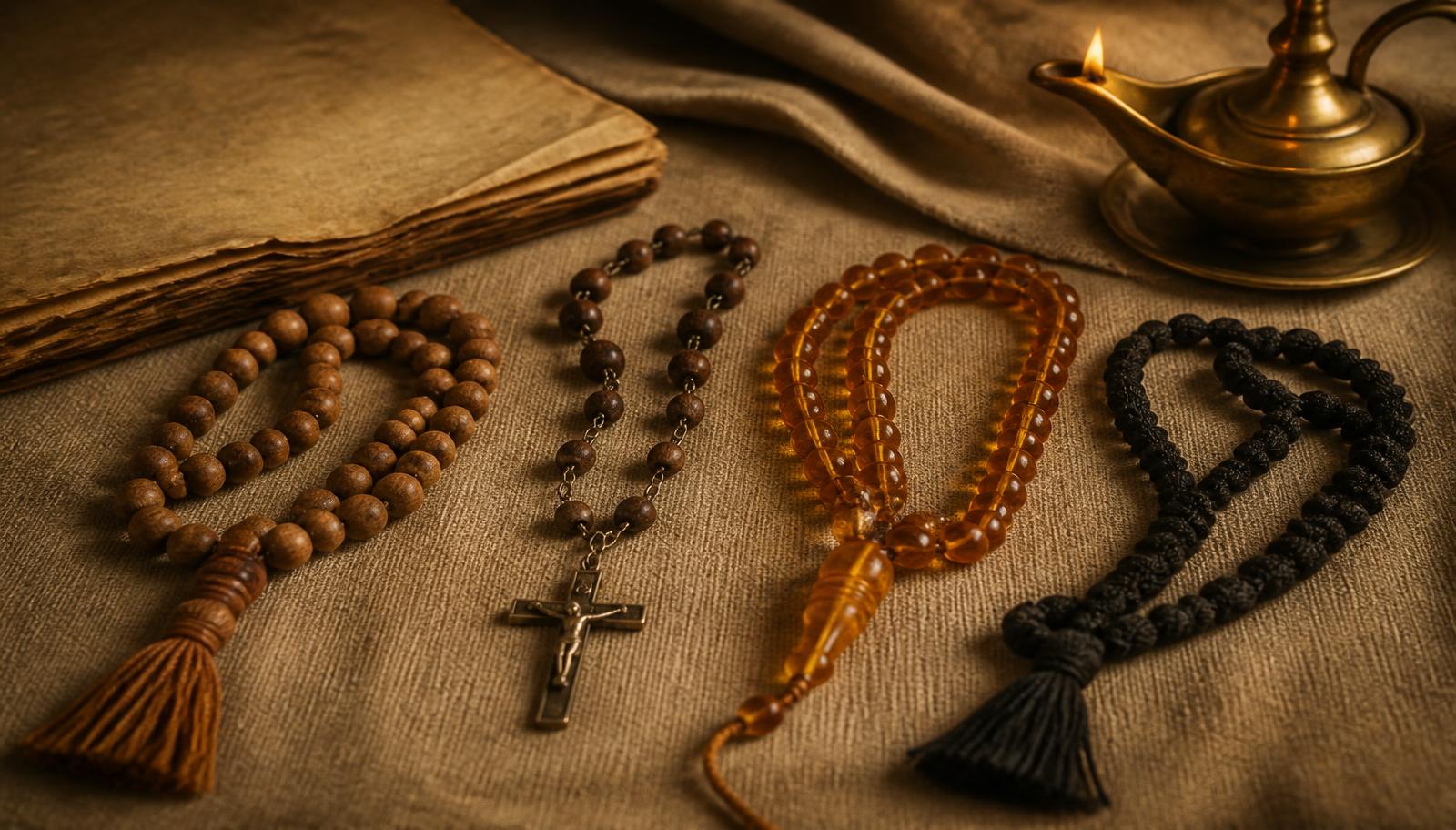
Prayer beads are a counting tool. A practitioner moves through the strand one bead at a time, and each bead marks one repetition — a mantra, a divine name, a fixed prayer. The hand keeps the count so the mind does not have to, which is the whole practical point: attention stays with the words rather than with the arithmetic.
That gesture — hand, breath, repetition, a physical object to return to — recurs across Hindu, Buddhist, Christian and Muslim practice. It is worth saying carefully what this recurrence does and does not mean.
A careful note
Related practices, not one practice
It is tempting to tell the history of prayer beads as a single story with one origin and a clean line of transmission. The honest picture is more restrained. Scholars continue to debate how much these traditions influenced one another and how much they arrived at counted prayer independently, and the surviving evidence for early transmission is thin in places. Each tradition has its own texts, its own instructions, and its own reasons for counting. This site treats them as parallel practices worth understanding on their own terms — described side by side, never merged into one system wearing different names.
The forms
Five strands, five traditions
Japamālā (Hindu)
A strand used for japa — the repetition of a mantra or a divine name. Commonly 108 beads with a larger guru bead marking the beginning and end. Rudrāksha seeds are long associated with Śaiva practice; tulsī wood with Vaiṣṇava practice.
Mālā (Buddhist)
Used to count recitations of mantras, refuge formulas, or the names of buddhas and bodhisattvas. Also commonly 108 beads. Materials and counting customs differ across Theravāda, Mahāyāna and Tibetan Vajrayāna settings, which have their own instructions and lineages.
Tasbīḥ / Misbaḥa (Muslim)
Typically 99 or 33 beads, used for dhikr — the remembrance of God — including the recitation of the divine names and short formulas of praise. Many practitioners count on the fingers instead, which is also traditional.
Prayer rope / Chotki (Orthodox Christian)
Knotted wool rather than strung beads, used for the Jesus Prayer repeated over a long period. Knots are commonly counted in 33s or 100s. Its use is closely tied to monastic practice and to spiritual direction.
What they share
The common ground
A fixed number. Every tradition settles on a count — 108, 100, 99, 33 — so that a round has a beginning and an end, and practice can be measured without being watched.
A marker bead. Most strands carry a distinct bead, knot, medal or crucifix that signals where a round closes.
Repetition over novelty. The words do not change from bead to bead. The practice depends on returning to the same words, not on finding new ones.
Oral transmission. In each case the words were taught aloud, learned by ear, and carried by voice long before they were written down — which is where the name of this shop comes from.
Where to go next
What we make and stock
The strands we currently offer are malas — wrist and full 108-bead strands drawn from Hindu and Buddhist practice. If you are new to them, the mala pages below cover how they are held, why the count is 108, and how to choose one.