Learn · 01
What Is a Mala?
A string of beads used to count repetitions during meditation or prayer — simple in purpose, and older than any single tradition can claim.
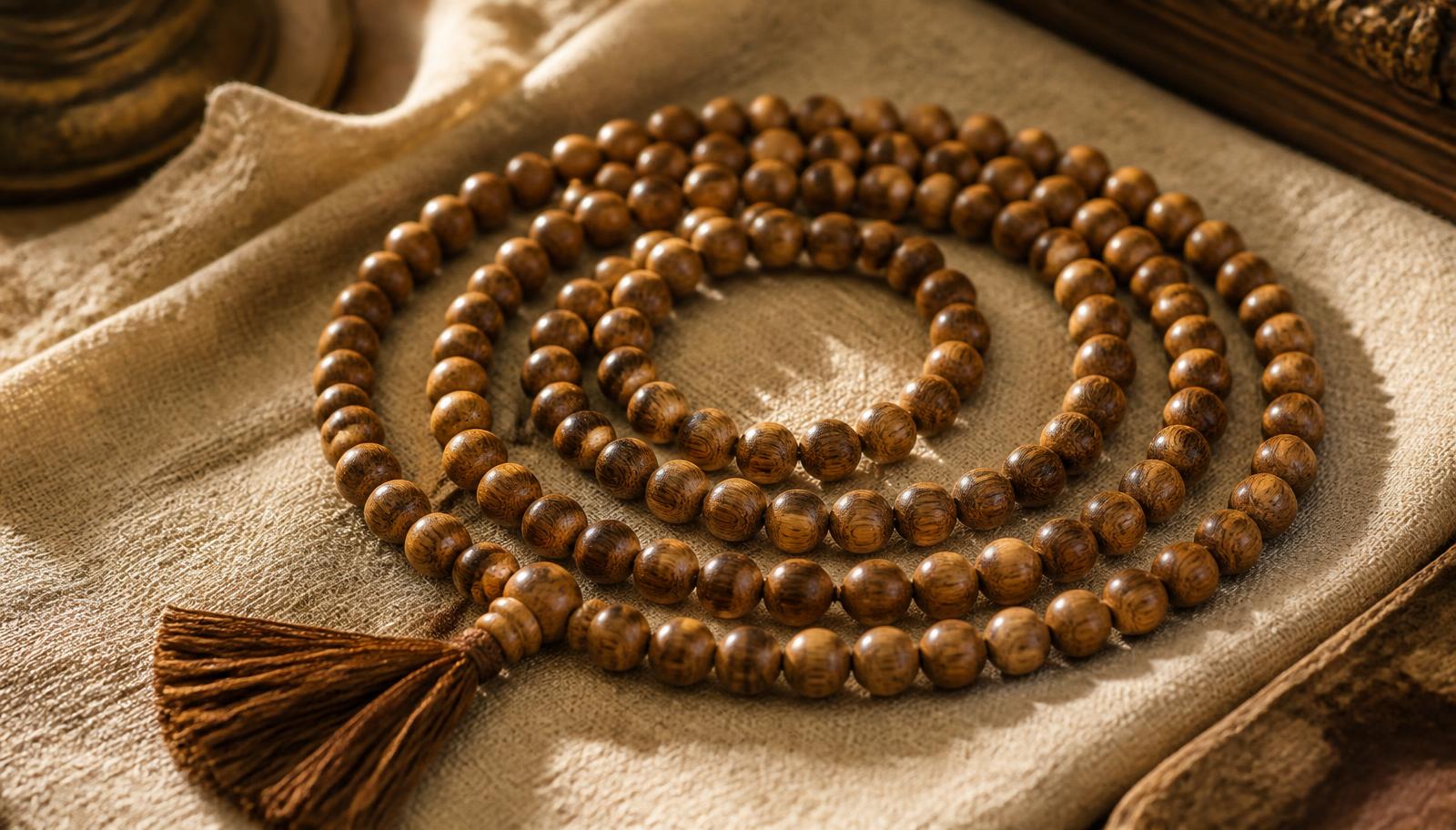
A mala is a strand of beads used to keep count while repeating a mantra, a prayer, or a name — a practice generally called japa. That's the whole definition. Everything else — the material, the number of beads, the tassel — is detail that supports this one function: letting the hand keep count so the mind is free to keep its attention on the words.
Most full malas have 108 beads, though wrist malas are commonly shorter — often 27, a quarter of 108. We look at why 108 specifically on its own page, since the honest answer takes more than a sentence.
Parts of a mala
What you're holding
Counting beads. The main run of beads — traditionally 108 on a full mala — each one marking a single repetition.
Guru bead (also called the meru bead). A single larger or distinct bead marking the start and end of the strand. It is not counted as one of the 108 and is not meant to be crossed over — more on that in How to Use a Mala.
Tassel. Traditionally attached at the guru bead. Its origins are practical as much as symbolic — a way to finish and secure the cord — though many practitioners also read it as an emblem of the many threads of practice gathered into one.
Spacers or dividers. Smaller beads placed at intervals, often every 27th bead, to help a practitioner sense position in a round without stopping to count.
Materials
What malas are made from
Rudrāksha. The dried seed of the Elaeocarpus ganitrus tree, used in japa practice within Śaiva traditions for centuries. Seeds vary naturally in size, color, and the number of grooves ("faces") on their surface.
Bodhi seed. Seeds associated with the bodhi (peepal) tree, under which the Buddha is said to have attained awakening, and used in Buddhist mālās.
Sandalwood. A fragrant wood used across Hindu and Buddhist practice for centuries, valued for its scent and its light weight for daily wear.
Gemstone. Later and more contemporary in this specific application; stones are chosen for color, weight, and the associations described throughout our Collections and Gemstone Guide.
A note on origins
Several traditions, not one story
Counted prayer strings appear in more than one tradition: the Hindu japamālā, the Buddhist mālā, and the Sufi tasbīḥ (also called misbaḥa) are the most widely used today. It is tempting to tell this as one story with a single origin and a line of transmission running through it — but the honest picture is more careful than that. Historians and scholars of religion continue to debate how much these traditions influenced one another versus developed their own counting practices independently, and the surviving evidence for early transmission is thin in places. What can be said plainly is that each tradition has its own history, its own texts, and its own reasons for counting — and this site treats them as related practices worth understanding on their own terms, not as one belief system wearing different names.